The Child in the Audience
In Hans Christian Andersen's fable, the emperor parades through the streets in clothes that do not exist. His court praises the invisible fabric. His subjects, afraid of appearing foolish, applaud. It takes a child — unschooled in the art of strategic silence — to say what everyone already knows.
Iran has just played the child.
This week, an advisor to Iran's parliament speaker published what amounts to a strategic doctrine in plain language: the current American administration cannot be negotiated with. Not will not. Cannot. The distinction is important. Iran is not describing a breakdown in talks. It is describing a structural incapacity — a counterparty that lacks the institutional coherence to make commitments it will keep, and the attention span to honour them if made.
"The path to victory is neither fighting nor a deal," Majid Shakeri wrote. "It is managing the process of neither war nor peace, up to the point of victory. The winning approach is denial, ambiguity, and strategic patience."
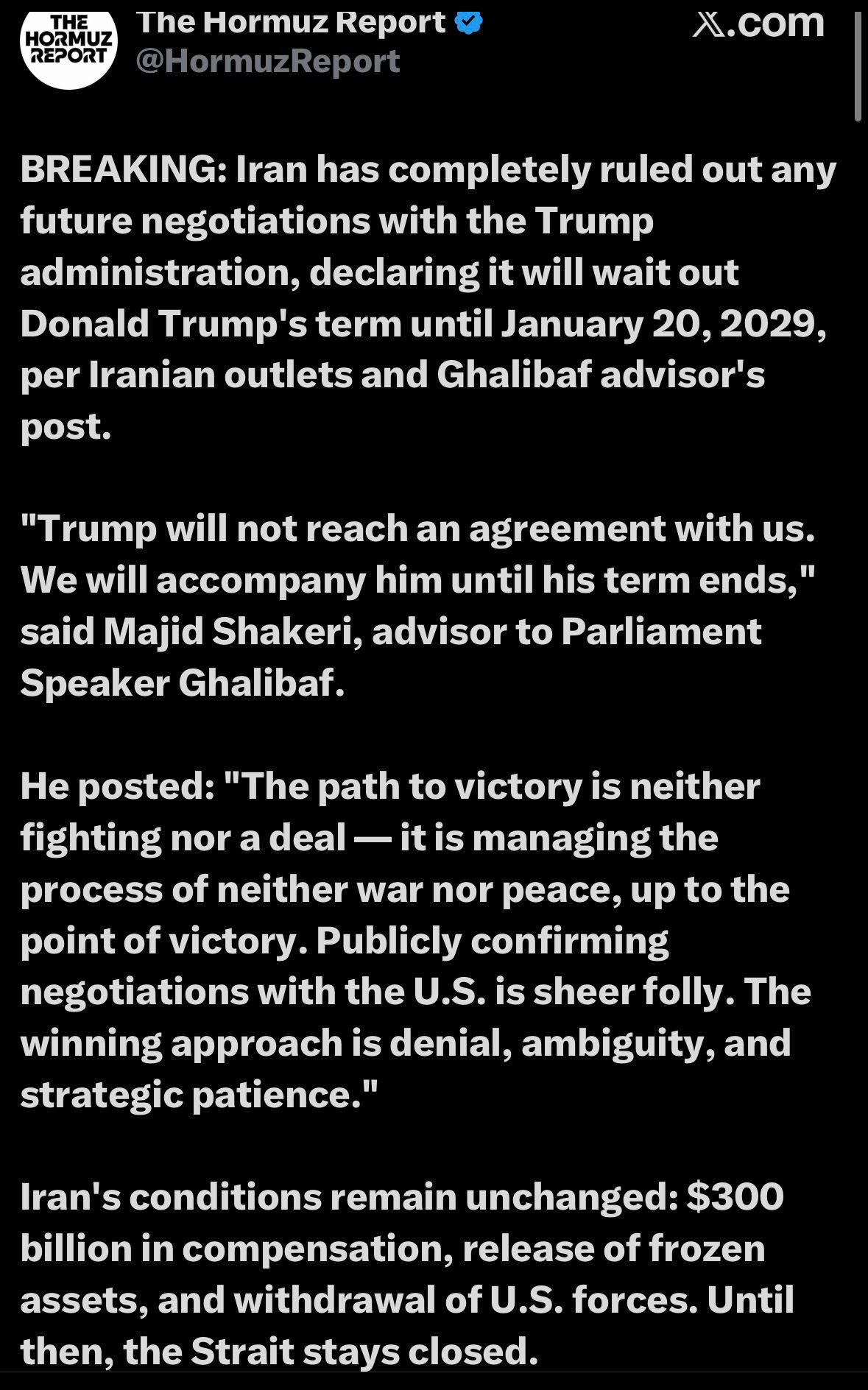
This is not a provocation. It is a clinical assessment. And its significance lies not in the content — which is obvious to anyone watching — but in the fact that it has been stated publicly, in English, for international consumption. Iran has decided the cost of naming the obvious is now lower than the cost of pretending otherwise.
I want to be careful here, because this essay is not about a man. It is about an institution. The distinction is the whole discipline: the problem, the attribution, and the solution are three separate questions, and collapsing them into a personality is how analysis becomes commentary.
The American presidency, at its functional best, was a commitment device. When a US president signed an agreement, the institutional weight behind that signature — the bureaucratic infrastructure, the treaty obligations, the congressional oversight, the professional civil service — gave it meaning beyond the individual. Counterparties could rely on continuity. The word of the office outlasted the person holding it.
That institutional weight has been progressively dismantled. Not in a single dramatic act, but through a thousand incremental decisions: the firing of inspectors general, the replacement of professional civil servants with political loyalists, the withdrawal from agreements on the personal authority of a single executive, the subordination of independent agencies to presidential preference. The machinery that gave the commitment device its credibility has been stripped for parts.
What Iran is saying — and what the international community is slowly, uncomfortably arriving at — is that the device no longer functions. You cannot negotiate with a system that cannot bind itself.
There is a passage in Thucydides where the Athenians tell the Melians, with devastating frankness, that the strong do what they can and the weak suffer what they must. It is remembered as a statement of power. What is less remembered is what followed: Athens destroyed Melos, then proceeded to destroy itself in Sicily, then collapsed entirely within a generation. The frank admission of power was also the beginning of its dissolution.
Power that cannot be constrained cannot be trusted. Power that cannot be trusted cannot build the alliances that sustain it. The erosion of institutional constraint is not a feature of strength. It is the mechanism of decline. The dismantling of the International Criminal Court's capacity is the cleanest recent example: an instrument broken to shield one ally, and unavailable the moment Washington's own interests needed it.
Iran has read Thucydides. Or at least, Iran has read history. Strategic patience — sabr — is not a new concept in Persian strategic culture. It has outlasted empires before.
The question this essay is really asking is not about Iran. It is about what comes after.
Iran's assessment implies something its statement does not quite say: that the institution may eventually recover. That January 20, 2029 represents a horizon after which normal counterparty behaviour resumes. There is a kind of optimism embedded in that framing — a belief that the damage is temporary, the institution resilient, the cornerstones intact.
I am not sure this optimism is warranted.
Building institutions is an orders-of-magnitude more time-consuming effort than tearing them apart. The professional civil service that was dismantled took generations to construct. The treaty infrastructure that was abandoned took decades to negotiate. The credibility of the commitment device — the foundational belief that an American signature means something — was earned through consistent behaviour across administrations of both parties over eighty years.
It can be lost in four.
By the time this period ends, it is not clear that the cornerstones will have survived. Not the physical buildings, not the constitutional text, but the operating assumption that underpins everything: that the United States is a reliable participant in the international order it helped construct. Europe has already been given the evidence in its own theatre — legislative language questioning a member state's sovereignty, territorial claims against a founding NATO ally — and has consistently chosen to read each instance as an aberration rather than a pattern.
Europe should listen to the child.
Not because Europe shares Iran's strategic interests — it does not. Not because Iran's approach is a model — it is not. But because Iran, unburdened by the diplomatic habits of alliance management, has stated plainly what European chancelleries are only permitted to think in private.
The response cannot be to wait for 2029 and hope. The response must be to begin, now, constructing the institutional architecture that does not depend on American reliability. Not out of hostility to America — Europe has no interest in American failure — but out of the simple recognition that a commitment device that no longer functions must be replaced, not waited upon.
That is, in the end, the same argument this site opened with: Europe is a project, not a heritage claim. Projects can be built. Inheritances can only be lost.
The child pointed at the emperor. Europe's chancelleries had a better view than anyone, for longer than anyone, and chose to applaud.
That is what has to change, and it can change immediately, because it costs nothing but nerve. European heads of state and government should state plainly — in public, on the record, in the language of official positions rather than anonymous briefings — what their own analysts have been writing in private for two years: that the United States is not at present a reliable treaty counterparty; that commitments made by this administration cannot be assumed to outlast it; and that European defence, industrial, and digital planning will proceed on that assumption, and be funded accordingly.
Saying it is not hostility, and it is not rupture. It is the precondition for everything that follows. A Europe that will not say the thing out loud cannot ask its parliaments to fund the remedy, cannot explain to its citizens why the bill has arrived, and cannot build the institutions that a functioning commitment device would have made unnecessary.
Iran said it because it had nothing to lose by saying it. Europe has considerably more to lose by continuing not to.
The emperor has no clothes. It should not have taken Tehran to say so.
JP Ahonen writes from the intersection of systems analysis and European strategic thought. He is the founder of CVPE.eu.